Website van Alex Reuneker over taal, hardlopen, wielrennen en reizen

Taal & Literatuur

Posts over taal en literatuur

The Evenings, day 2: 23 December 1946/2025

Today, we're reading chapter 2 of The Evenings. I thought it would be fun to look at sentence lengths in that chapter and compare them between the original Dutch text and the English translation. There's no reason to expect a real difference – it's simply for fun.

First, the Dutch text. pasting the chapter into the sentence-length calculator at https://www.reuneker.nl/files/senlen tells us that there are 650 sentences, with a total number of 6720 words, and an average of 10.34 words per sentence (sd = 6.28). For the English translation, there were 3 sentences more (653), with a total number of 7135 words, and an average of 10.93 words per sentence (sd = 6.81). We already see that these numbers are very similar, but let's test for a difference anyway to see if there's something interesting to be learned.

Using the t-test calculator at https://www.reuneker.nl/files/t we get the following results. For De avonden (n=650), the sum total of words is 6720, the minimum number of words in a sentence is 2, the maximum is 40, the mean is 10.34, the median is 9 words, and the standard deviation is 6.28 words. For The Evenings (n=653), the sum total of words is 7135, the minimum number of words in a sentence is 2, the maximum is 44, the mean is 10.93, the median is 9 and standard deviation is 6.81. The difference in sentence lengths between The Evenings and De avonden is not significant (t (1301) = 1.62; p >= 0.05). The effect is negligible (Cohen's d = 0.09; Cohen, 1988). In a boxplot, that looks like this – indeed, nearly identical.

Sentence lengths in De avonden and The Evenings

Sentence lengths in De avonden and The Evenings

So, which sentences are those very long ones, then? And are they the same sentences across both editions? The answer is yes, as you can see below.

Dutch Op de trap, bij de kaartencontrole, troffen ze elkaar weer en liepen langs een spandoek met het opschrift Berends gymnasium, 1926-1946 naar boven, waar ze in een hal, kleiner dan die beneden, voor de ingang van een zaal kwamen.

English At the foot of the stairs, where the ticket takers stood, they met up again and climbed past a banner reading Berends Gymnasium, 1926-1946 and then, in a hall even smaller than the one below, found themselves before the entrance to an auditorium.

The Evenings, day 1: 22 December 1946/2025

Today, December 22nd of 2026, is the first day of reading The Evenings, the translation of De avonden by Gerard Reve. Reading this classic from 22-31 December is a tradition in Holland, although I have no clue how many people actually do it. This year, however, my wife also joins, so that makes for at least two. By reading it from 22 December until New Year's, a chapter a day, each chapter matches the day on which you read it.

It was kind of a weird experience reading the first chapter in English today. I know the book so well from all the annual readings, that I remember some passages by word. And now, of course, the actual words have changed. My first impression is that it makes the scenes at home with Frits, his mother and father less 'stingy', a bit nicer and more comfortable than they appear in the Dutch text – especially where Frits is concerned, because he really isn't a very nice person. This is reflected less in this English translation, I think. As I've read only the first chapter yet, let's not draw any real conclusions yet, though.

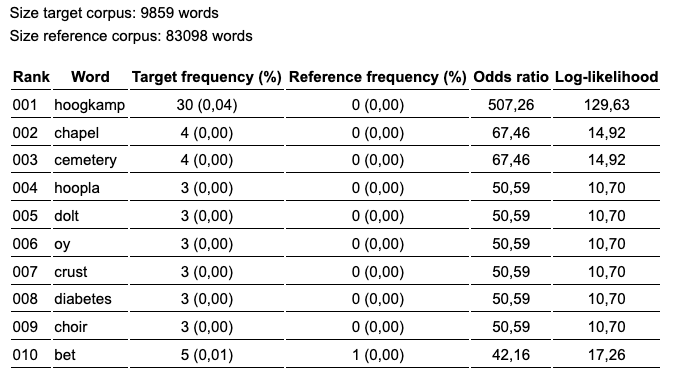
As I'm not only a nerd with respect to literature, but also to numbers, I conducted some quick lexical tests on the first chapter. I found it quite funny to see that one of the strongest n-grams in the chapter, and probably throughout the book, turns out to be the fourgram 'he said to himself'.

Fourgrams in the first chapter of The Evenings

Fourgrams in the first chapter of 'The Evenings'

Yes, Frits talks to himself quite a lot, which is part of the appeal of the book, I think: you get to know Frits on a really personal, intimate level, as you not only are invited into his inner musings, but you can also frequently witness the differences between what Frits actually thinks, and what he eventually says.

Looking forward to tomorrow!

Welke 'De Avonden' dit jaar?

Al jaren lees ik van 22 december tot en met oudjaar De avonden van Gerard Reve. Zo'n traditie vind ik heerlijk, niet in de laatste plaats omdat je weet dat je niet alleen bent – je bent natuurlijk bij de beslommeringen van Frits van Egters, maar ik bedoel vooral dat er nog meer mensen zijn die precies op deze dagen steeds een hoofdstuk uit deze literaire klassieker lezen. Zie daarvoor overigens ook het commentaar op https://neerlandistiek.nl/2025/12/zo-ver-weg-van-och-jeetje-achguttoch en lees dan vooral ook de mooie recensie van Marc van Oostendorp van Eric de Rooijs Uit tallozen, jij.

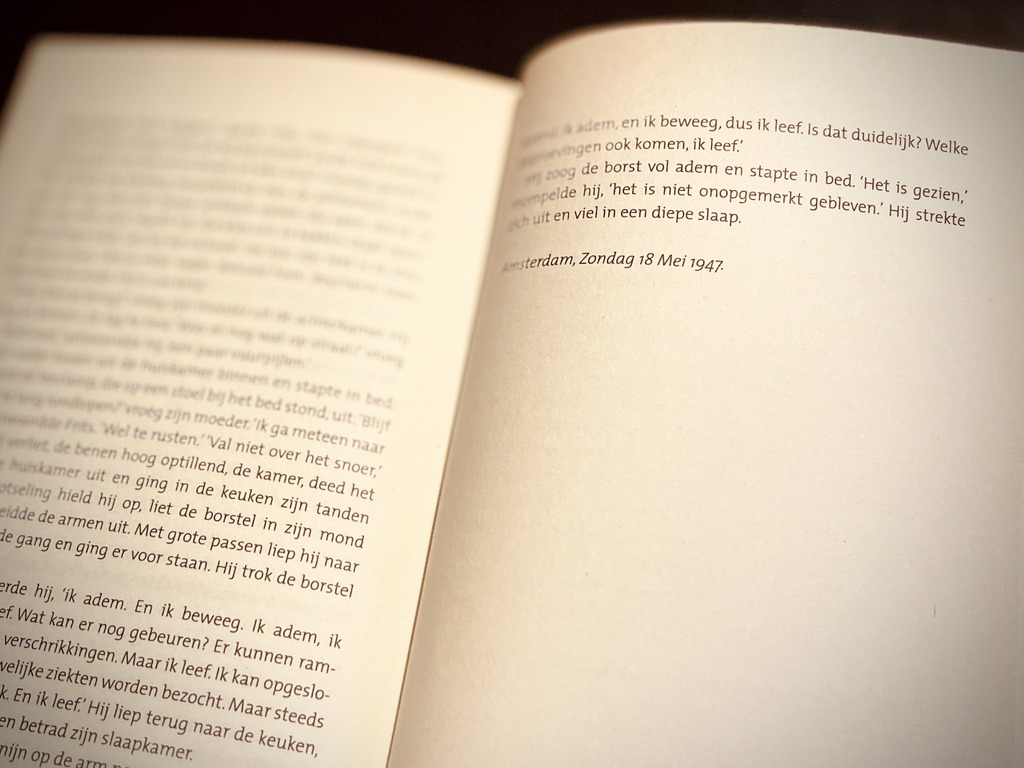
Toch is een beetje variatie op z'n tijd ook niet vervelend. Zo las ik vorig jaar voor de verandering eens de 'verstripping' van Dick Matena, het jaar ervoor, als ik het me goed herinner, de tweede druk en het jaar daarvoor de eerste. Ook heb ik een jaar met veel genoegen het luisterboek op cd beluisterd (inmiddels natuurlijk ook al weer hartstikke ouderwets), waarop een al oude Reve het boek voorleest. Heerlijk. Maar wat blijft er dan over voor dit jaar?

De Avonden in Engelse vertaling

De Avonden in Engelse vertaling

Niet lang na het verschijnen ervan staat hier ook de Engelse vertaling The Evenings in de kast, maar die uitgave heb ik nog steeds niet gelezen. Dat wordt 'm dus dit jaar. Afkicken van moeders 'hoei boei'? Misschien, want dat is in de vertaling van Sam Garret goodness gracious geworden, dat ik overigens toch vooral uit Jerry Lee Lewis' Great Balls of Fire ken.

Hirsch-Popescu Point added to Lexical Diversity Calculator

The Hirsch-Popescu Point (Popescu & Altmann, 2006) is an interesting metric to assess repetition in a text. It is determined by first calculating the frequency distribution of all words in the text. Then, words are ranked from the most frequent to the least frequent. The H-P Point is then defined as 'the point in which the ranking of a word in the distribution matches its frequency, just like the h-index in academia' (see Nunes, Ordanini, Valsesia, 2017, p. 20; Hirsh, 2005). Indeed, the h-index is a well-known measure of productivity and citation impact of publications. The smaller the H-P point, the less repetition a text contains and vice versa, i.e, the greater the HP-point, the more repetition a text contains.

If we apply the calculation to an example text, we easily see how it works exactly. The text used here is Sylvia Plath’s poem 'Lady Lazarus' (1965), and the resulting frequency table (distribution of words) can be seen below.

Word distribution in https://www.poetryfoundation.org/poems/49000/lady-lazarus”>Sylvia Plath’s poem ‘Lady Lazarus’ (1965)

Word distribution in Sylvia Plath’s poem ‘Lady Lazarus’ (1965)

In this table, we see that the word of occurs eight times in the poem, and it is also ranked at position eight in order from most to least frequent words. Therefore, 8 is the H-P Point. Of course, this frequency table, the sorting and determining the actual point at which frequency and order coincide is done by the Lexical Diversity Calculator for you, as can be seen below.

The Hirsch-Popescu Point as calculated by the Lexical Diversity Calculator

The Hirsch-Popescu Point as calculated by the Lexical Diversity Calculator

As always, if you find it useful, have fun!

'Ben stil' of 'wees stil'?

  in Taal & Literatuur
 

In de aanstaande publicatie ‘Onthoud de gebiedende wijs! De spelling van de gebiedende wijs in het voortgezet onderwijs’ in Tijdschrift voor Nederlandse Taal- en Letterkunde (TNTL) die ik samen met Franka Hogewoning schreef, zochten we uit hoe het nu precies zit met de gebiedende wijs wees, als in ‘Wees nou eens stil!’. Je hoort tegenwoordig ook wel ‘Ben stil’, maar die vorm lijkt toch nog niet helemaal doorgebroken. Wat is het verhaal?

'Wees nou eens stil!'. Foto door Kristina Flour op Unsplash

'Wees nou eens stil!'. Foto door Kristina Flour op Unsplash

Persoonsvormen zijn werkwoordsvormen die congrueren met hun onderwerp en die aanduiden of een gebeurtenis of een situatie gelijktijdig ofwel voortijdig is aan het spreekmoment. In de Algemene Nederlandse Spraakkunst wordt de gebiedende wijs een persoonsvorm genoemd, ook al is het onderwerp van de zin niet uitgedrukt, zoals in ‘Ga zitten.’ (Haeseryn et al. 1997: 44). In de traditionele grammatica heeft de gebiedende wijs twee vormen. De eerste en meest gebruikte vorm is gelijk aan de stam of eerste persoon enkelvoud tegenwoordige tijd (zie o.a. Van der Velde 1956: 77; Nederlandse Taalunie 2005: 75). Zo stelt Onze Taal dat in ‘Word lid van Onze Taal’ […] word een gebiedende wijs [is] en die is gelijk aan de ik-vorm van het werkwoord. Er komt dus geen t achter word.’ In sommige bronnen wordt vermeld dat de vorm gelijk is aan ‘de vorm van het werkwoord die hoort bij de tweede persoon, met jij erachter’ (Renkema 2020: 451; zie ook Den Hertog 1903: 39). Die laatste omschrijving lijkt, ook getuige de opmerking ‘we mogen noem als vorm voor de 1e pers. enkelvoud niet gelijkstellen met noem als vorm voor de gebiedende wijs, zoals vergelijking met ben en wees leert’ in de Spraakkunst van Rijpma en Schuringa (1972: 69), als instructie, ingewikkelder, maar wel correcter. Hieronder laten we zien wat dat nu met wees te maken heeft.

Bij enkele vormen is de specifieke werkwoordsvorm voor de gebiedende wijs in gebruik gebleven en daarin zien we de overeenkomst met de persoonsvorm van de tweede persoon enkelvoud, zoals in ‘Wees jij nu eens stil!/Wees nu eens stil!’ en niet met die van de eerste persoon enkelvoud, zoals in ‘Ik ben stil./? Ben nu eens stil!’ Hier zien we tevens waarom de gebiedende wijs als persoonsvorm wordt gezien; wees is de specifieke vorm die hoort bij de gebiedende wijs van het werkwoord zijn. De gebiedende wijs ben lijkt wel in opkomst te zijn, maar behoort volgens de Algemene Nederlandse Spraakkunst (nog) niet tot de standaardtaal (Haeseryn et al. 1997: 66-67). Wel speelt regio een rol (Onze Taal). Proeme stelt dat ‘de persoonsvormen in imperativuszinnen geheel overeenkomen met persoonsvormen in mededelende zinnen’ en dat er daarom in imperatiefzinnen, net als in mededelende zinnen, ook werkwoordsvormen voor kunnen komen die niet in tegenwoordige tijd staan (1984: 248).

Volgens De Haan (1986: 253) is de gebiedende wijs als specifieke werkwoordsvorm door taalverandering verdwenen, op ‘een relict als de vorm wees bij zijn’ na. De infinitief zijn is, volgens het Woordenboek der Nederlandsche Taal, een jongere pendant van wezen die in het Middelnederlands al sterk aanwezig is. Toch blijft wezen ook buiten de gebiedende wijs nog tot in de twintigste eeuw in gebruik, vooral in geschreven taal (WNT). Vroeger was er een aparte vorm voor de gebiedende wijs, maar de gebiedende wijs is veranderd in een zinstype dat voldoet aan een of meer kenmerken, zoals het ontbreken van een onderwerp, een persoonsvorm die vooraan staat in de zin, een werkwoordsvorm die bestaat uit de stam en in de tegenwoordige tijd staat. De opmars van zijn ten koste van wezen lijkt echter (nog) niet de imperatief wees te hebben verdrongen.

Lees, om toch maar af te sluiten met een gebiedende wijs, binnenkort meer in het komende nummer van Tijdschrift voor Nederlandse Taal- en Letterkunde (TNTL).

Pagina 6 of 20