Website van Alex Reuneker over taal, hardlopen, wielrennen en reizen

The Evenings, day 10: 31 December 1946/2025

Today is the last day of the year, and with that, the last day of reading The Evenings. The novel is famous for a number of reasons, but one of them must be one of its last sentences, which, in the Dutch original, goes as follows.

'Alles is voorbij', fluisterde hij, 'het is overgegaan. Het jaar is er niet meer. Konijn, ik ben levend. Ik adem, en ik beweeg, dus ik leef. Is dat duidelijk? Welke beproevingen ook komen, ik leef.' Hij zoog de borst vol adem en stapte in bed. 'Het is gezien', mompelde hij, 'het is niet onopgemerkt gebleven.'

The key sentence here is '"Het is gezien", mompelde hij, "het is niet onopgemerkt gebleven."'
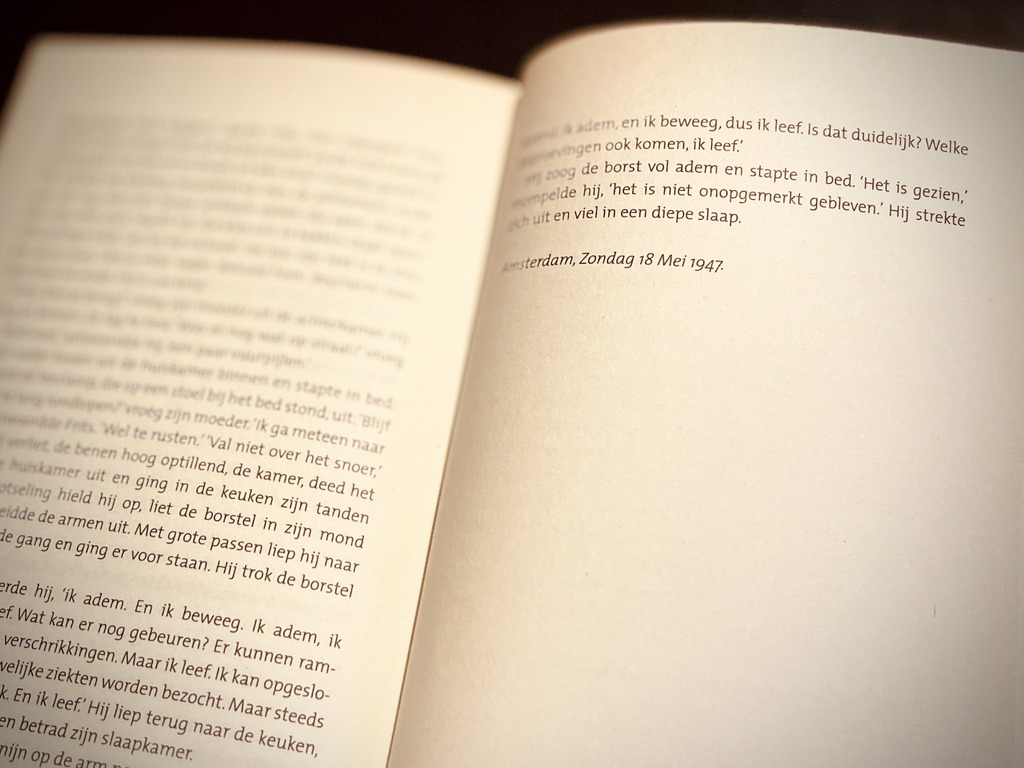
The last sentences in Gerard Reve's De Avonden

The last sentences in Gerard Reve's De Avonden

How is this famous, quite poetic sentence translated? Let's look at the English translation below.

'Everything is finished,' he whispered, 'it has passed. The year is no more. Rabbit, I am alive. I breathe, and I move, so I live. Is that clear? Whatever ordeals are yet to come, I am alive.' Drawing his lungs full of air, he climbed into bed. 'It has been seen,' he murmured, 'it has not gone unnoticed.' He stretched himself out and fell into a deep sleep.

'It has been seen,' he murmured, 'it has not gone unnoticed' – a quite literal, but very fitting translation. As in the original, it captures, I think, Frits' fear of (his) life being aimless, purposeless, and of leaving no lasting mark on history.

Unfortunatly, we didn't even touch on the debacle of Frits' mother buying wine that turns out to be berry-apple juice, which Frits doesn't seem to be able to let go. Nor did we go into the non-translation of oliebol. Although there are translations like Dutch doughnut available, the translator chose to leave the word as is – 'His mother came in with a plate of oliebollen.' – probably to stress how typically Dutch the snack is. (This is not to say that the oliebol or oliekoek originated in The Nethelands. See this Dutch newspaper article, for instance.)

Let's end this year's reading of The Evenings anyway. I had a lot of fun reading the English translation this year. Now there's 355 days left to decide on next year's version or translation. But first: champagne and oliebollen! Have a very nice New Year's Eve!
The Evenings, day 9: 30 December 1946/2025

Day nine, the penultimate chapter of The Evenings! What is the chapter about? Well, we'd have to read the chapter to answer that question, of course, and I will do just that this afternoon, but we can already get a grasp by doing another keyword analysis. We'll approach the analysis a bit different, however, as we will not use the British National Corpus as a reference, like we did on day three, but we'll compare today's chapter to the rest of the book, so chapter 1 to 8 and chapter 10. That way, we're sure we'll make a fair comparison, and atop that, we will not have the problem of (Dutch) names dominating the list of keywords.

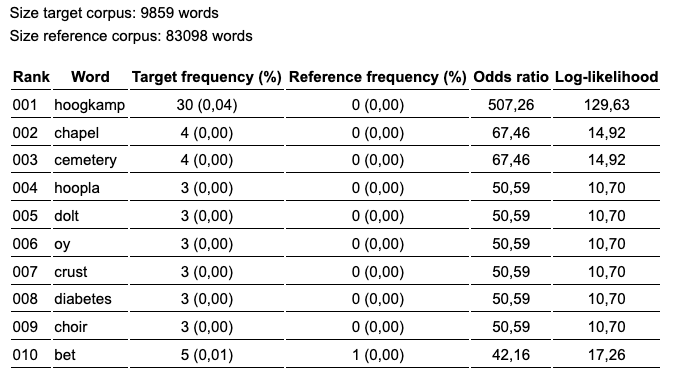
If we leave all default options on in the Keyword Analysis Tool, we get the following keywords for today.

Keywords in chapter 9 of The Evenings, including zero counts

Keywords in chapter 9 of The Evenings, including zero counts

Still, we see hoogkamp, a name, on first position, which is not unexpected, because Frits meets with him for the first time today. As Eduard Hoogkamp introduces himself by his surname ('the young man who had introduced himself as Hoogkamp'), this name is indicative of this chapter. It occurs thirty times, much more often than the other keywords in the list, such as chapel, cemetery, and, a personal favourite, hoopla. That last word is interesting, as the Dutch original reads 'hoepla, hoepla, hoeplala', but the English translation does not double the last syllable in the last repetition. It simply reads 'hoopla, hoopla, hoopla'.

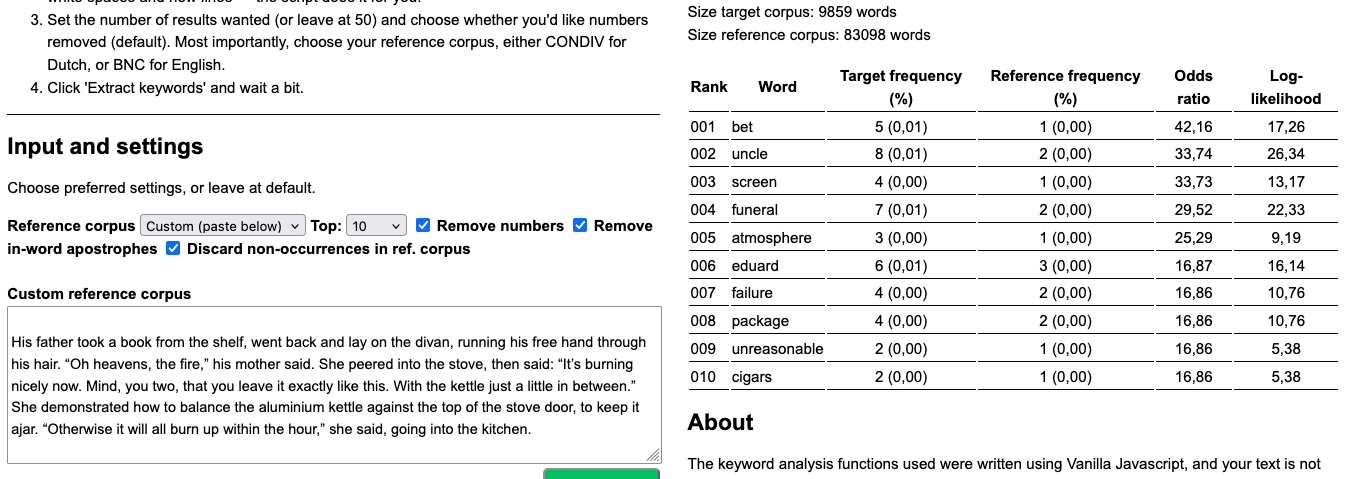
But what about the fact that most keywords in the top 10 do not occur at all in the reference corpus? To those so-called 'zero counts', a frequency of 0.5 is assigned, which is the default solution in keyword analysis, but I have just added an option to the Keyword Analysis Tool to discard words from the results that do not occur in the reference corpus. Let's see what this does to the results.

Keywords in chapter 9 of The Evenings, excluding zero counts

Keywords in chapter 9 of The Evenings, excluding zero counts

Now we see hoogkamp has left, as it does not occur outside of today's chapter. Interestingly enough, the character by that name is referenced to again outside chapter 9, but only by his first name Eduard (see position 6 in the results). Other keywords that do occur in the rest of the novel, but are significantly more frequent in chapter 9 are bet, uncle, screen and funeral. Bet occurs five times and all on the same page, when Jaap tells the following anecdote, which always makes me laugh, as it is both funny and really inappropriate.

'Don’t let me forget to tell you about that bet,' Jaap said. 'Then,'' Frits continued, 'we have baldness as a result of a disease of the hair or the subcutaneous fat, and thirdly there is baldness due to old age. And if you ask me, I believe that yours is a case of number two: a hair disease.''

'Have you heard the one about the fellow who says to his friend: you’re not healthy, I bet you have anaemia?' Jaap asked. 'So he says: I bet you have anaemia. No, come on, the other fellow says. Sure as sure can be, the first one says, would you like to bet? They bet twenty-five guilders on it and the second fellow goes to the doctor for a check-up. The first one waits outside. After a while his friend comes out of the office, skipping and dancing”—he spread his arms as though taking flight — and he shouts: Ha! I won! I have stomach cancer!'

All in all, keyword analysis can provide some more quantitative insight, but the real fun is in reading, of course. So, have fun reading again today!

The Evenings, day 8: 29 December 1946/2025

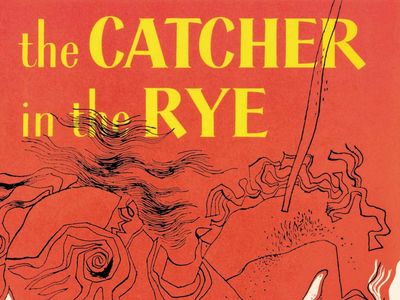
Today is day eight, on which Frits suffers from a hangover from the night before, in which ad fundum proved to be a favourite exclamation. Frits wakes up 'with a mouth dry as cork' and takes upon himself to get out of bed, wash up and be done with it, but he falls asleep again. Given Frits' hangover, let's take it easy today and look briefly at a little comparison between Reve's The Evenings and the American coming-of-age novel The Catcher in the Rye by J.D. Salinger, with which Reves novel is sometimes compared. It won't be a detailed comparison, but just some quick linguistic/lexical facts.

The Catcher in the Rye

The Catcher in the Rye (image by Britannica.com)

The Evenings consists of 92.680 words, of which 7.017 are unique, resulting in a type-token-ratio of 0.08. (Again, you can use the Lexical Diversity Calculator to calculate these and more figures yourself.) The Catcher in the Rye is a bit shorter, with 73.629 words of which 4.511 are unique, providing us with a type-token-ratio of 0.06. The mean word lenght in the former novel is 4.11 letters, in the latter it is 3.90. The average sentence length in The Evenings of 10.38 words is however lower than that of the The Catcher in the Rye with 11.03 words. Interestingly, using the Lempel-Ziv-Welch algorithm (Welch, 1984), we see identical compression rates, namely 0.81 on a scale from 0 (no repetition) to 1 (maximum repetition), meaning both novels contain an equal amount of repetition.

Have fun reading today (and go a bit easy on Frits...).

The Evenings, day 7: 28 December 1946/2025

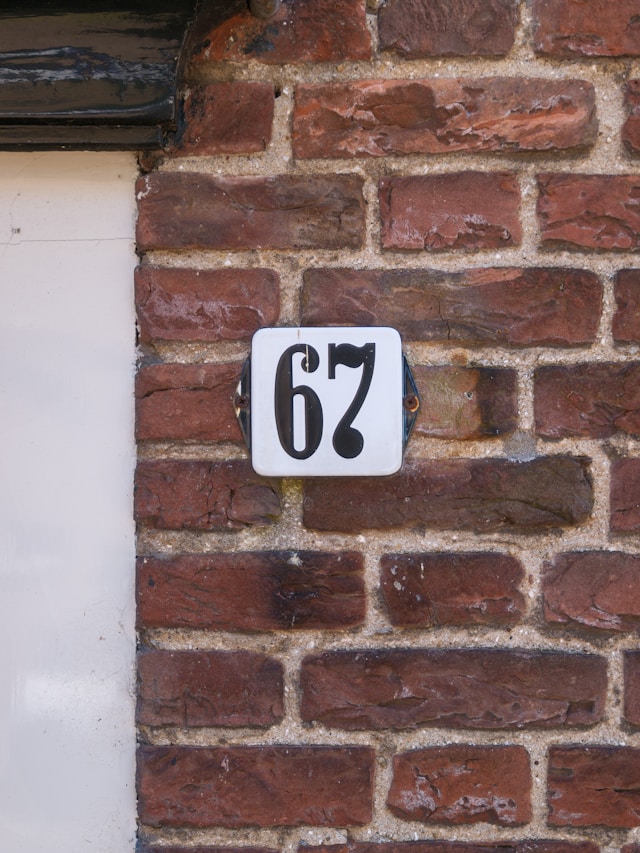
Day seven of The Evenings. Seven comes after six, and that rings of 'six-seven', children's word of the year of 2025 in The Netherlands! You can read about that at NOS Jeugdjournaal. Think of it what you will, but let's use this interesting word as a gateway into today's chapter.

Photograph by Haberdoedas on Unsplash

Photograph by Haberdoedas on Unsplash

The 67th word – which you can easily find using the Lexical Diversity Calculator – is mother, with which Frits' mother ends the following note she left for him.

Dear Frits. I don’t know where Father is. I have gone to Annetje’s. I will be home around eleven. There is pea soup, and you can take a piece of meat if you like. Just fry some potatoes along with the onions. Until then. Mother.

It really is a quite touching note, as Frits' parents clearly have relational issues, and while Frits really doesn't speak nicely of his parents, he does seem affected by their quarrels. His mother leaving for the day is not the first time, and I think it makes Frits' isolation the more apparent.

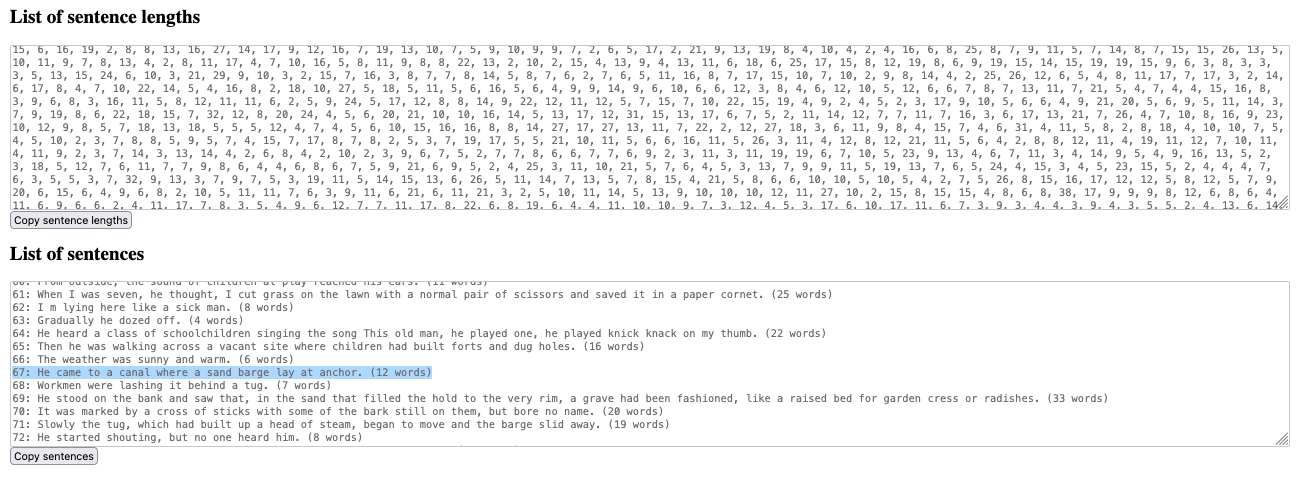
So what about the 67th sentence? You can find it using the Sentence Length Tool. Here it is: 'He came to a canal where a sand barge lay at anchor.' Frits just listened a bit to the radio and doesn't know what to do next, being home alone. He decides to go rest a bit, as not to be 'drowsy this evening.' He hears children playing, dozes of and dreams of a ship with a funeral cross. When he finally wakes up at five thirty, the chapter reads, his pillow is wet with tears.

The 67th sentence in chapter 7 of The Evenings

The 67th sentence in chapter 7 of The Evenings

While it is easy to critize Frits for being distant, sarcastic and very judging all the time, this chapter always reminds me to feel sorry for him too. The situation with his parents at home is less than stellar, and after not finishing school, Frits seems to be one of the few who hasn't moved on in life, his former school friends studying, being in relationships, et cetera. I think Frits' sarcastic comments, and his reliance on silly anecdotes for social interactions reflect his loneliness and his sense of it all being meaningless.

Returning to six-seven, Kristel Doreleijers, linguist at the Meertens Instituut, explains to NOS Jeugdjournaal that 'it's really a word of this year, but it doesn't have much meaning [...]'. Maybe that's what also lacks from Frits' life at this point: some meaning, something to rival the hopelesness of feeling not to have a purpose in life.

The Evenings, day 6: 27 December 1946/2025

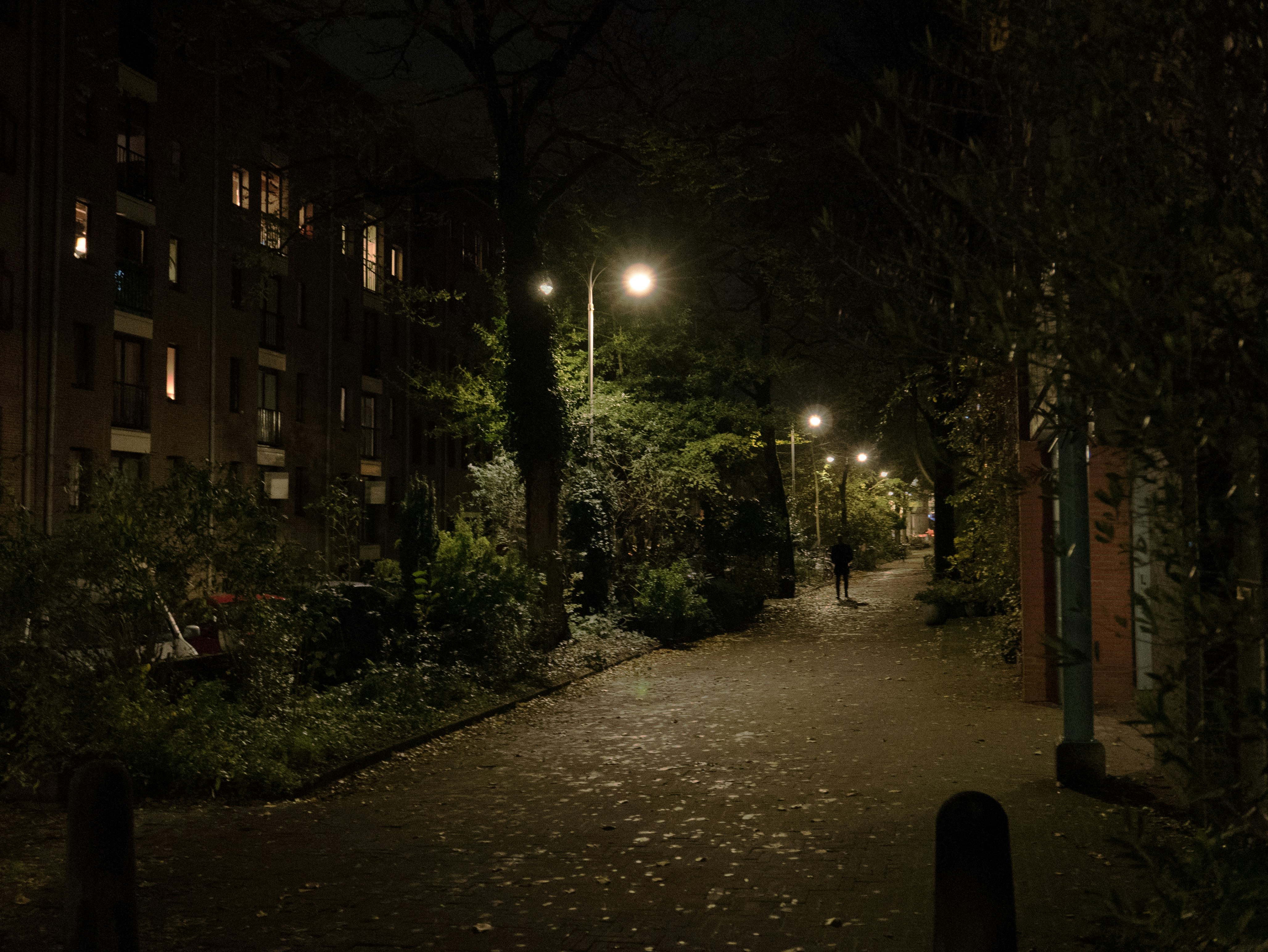
Christmas has passed and it's day six of The Evenings. Today's chapter begins not with Frits waking up, but right in the middle of the afternoon, with Frits being at the office, where the lights have to be turned on at a quarter past three, because it was already getting dark outside.

Early darkness on day six of The Evenings

Early darkness on day six of The Evenings. Photograph by Fons Heijnsbroek on Unsplash.

Yesterday, we looked at hapax legomena, or words that appear only once in a text. So, why not look at dis legomena today? Dis legomena are words that occur exactly twice in a text, and most often, they are a lot less frequent than hapaxes. For instance, today's chapter hosts 925 hapaxes, and 'only' 255 dis legomena. One that caught my eye, was oem, of which I thought it might be part of those weird little songs Frits sometimes hums or sings. We'll look into those later, as it may be interesting to see how those are translated, but we'll stick to oem for now. The word appears twice and it actually is the name of a lady in the following little story Frits finds in Viktor's book.

He leafed on. 'Janet: the gentlemen will surely remember,' he read, 'the case of the lady Oem, whose cat had died. I can, to my great satisfaction, report that her recovery is complete. Thanks to a remarkable course of treatment which I, in this case, applied. My treatment of Miss Oem consisted of giving her a new cat.'

Another word occuring exactly twice is lipreader, which draws the attention to quite a funny bit about sitting next to a lipreader in the movie theatre. There are, according to Frits, two types. First, there are 'the extroverts, who laugh and explain things to those sitting beside them. Those are truly terrible.' But there's a worse type of lipreader, 'the ones who read the subtitles out loud. Aye-aye, Jesus Christ, what an abomination.' I find these small observations very funny, because they both ring true, and are things you could think yourself, but would not readily say out loud.

Movie theatre

Movie theatre. Photograph by Jake Hills on Unsplash.

Have fun reading again today!

Pagina 1 of 3