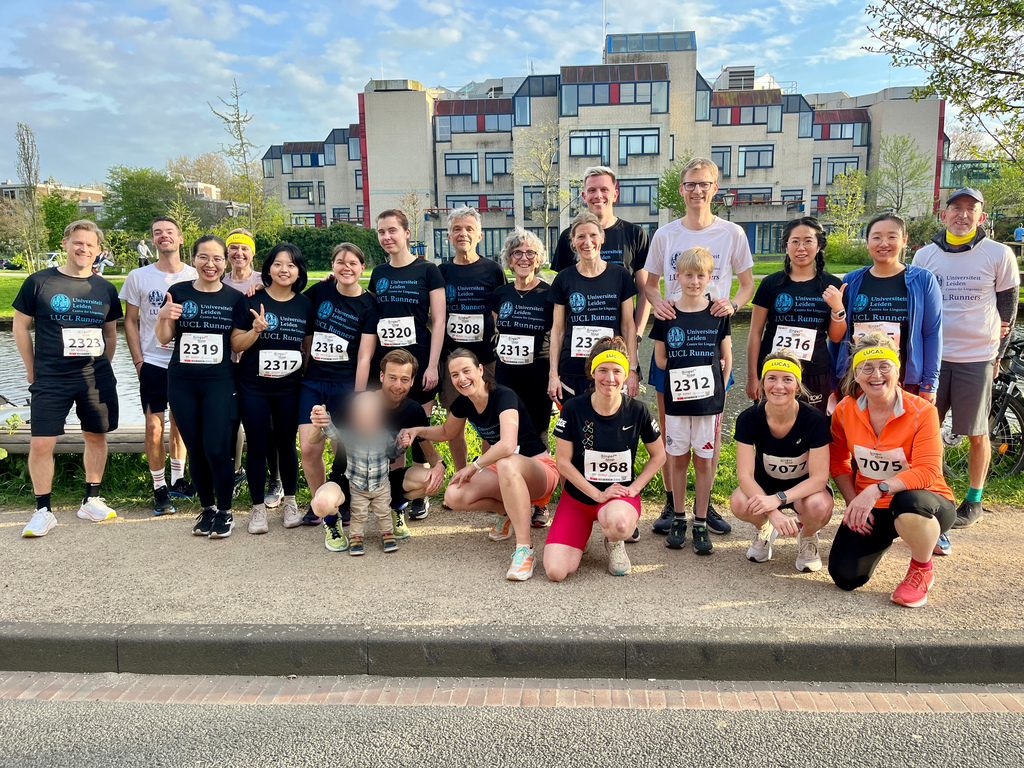
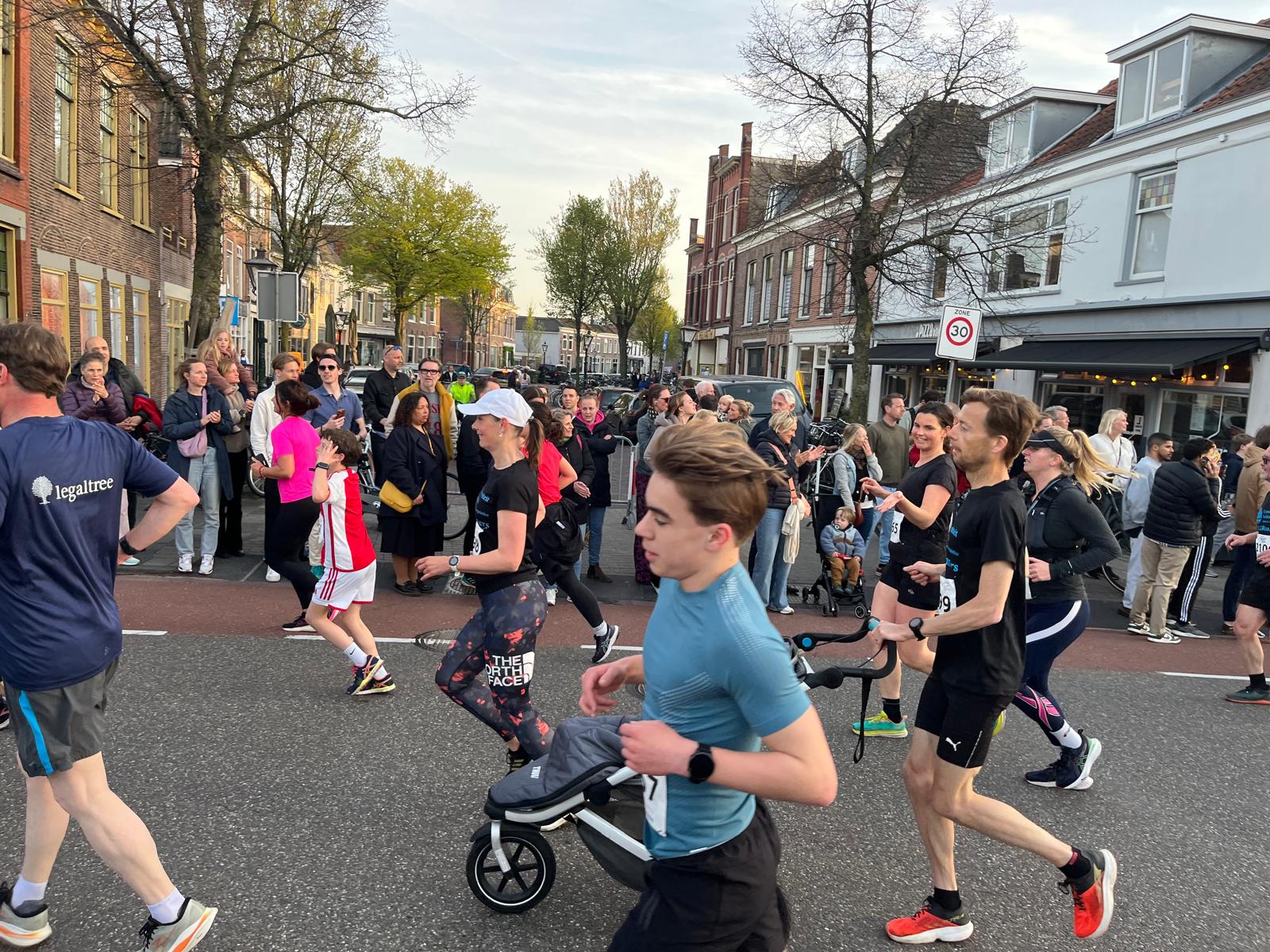
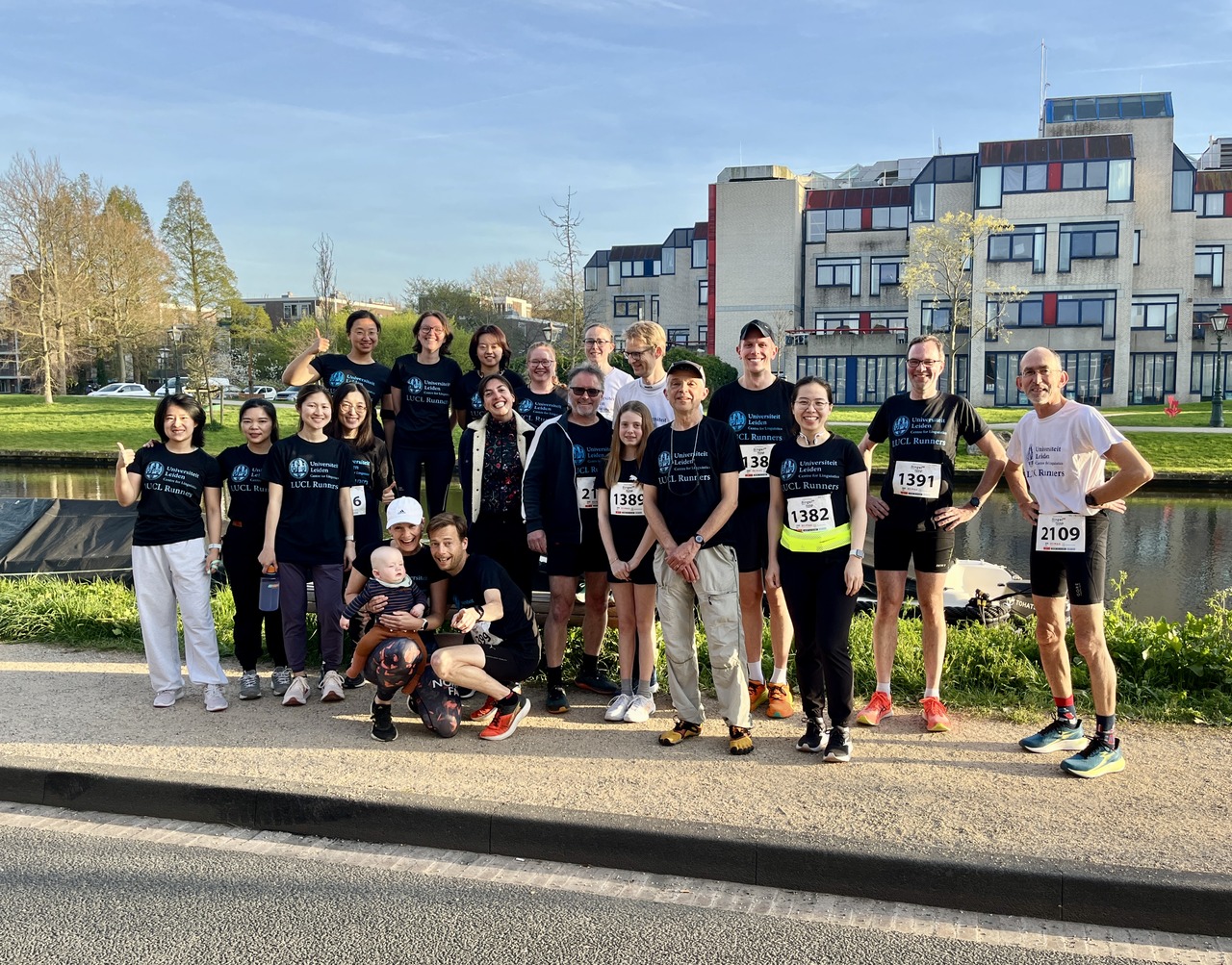
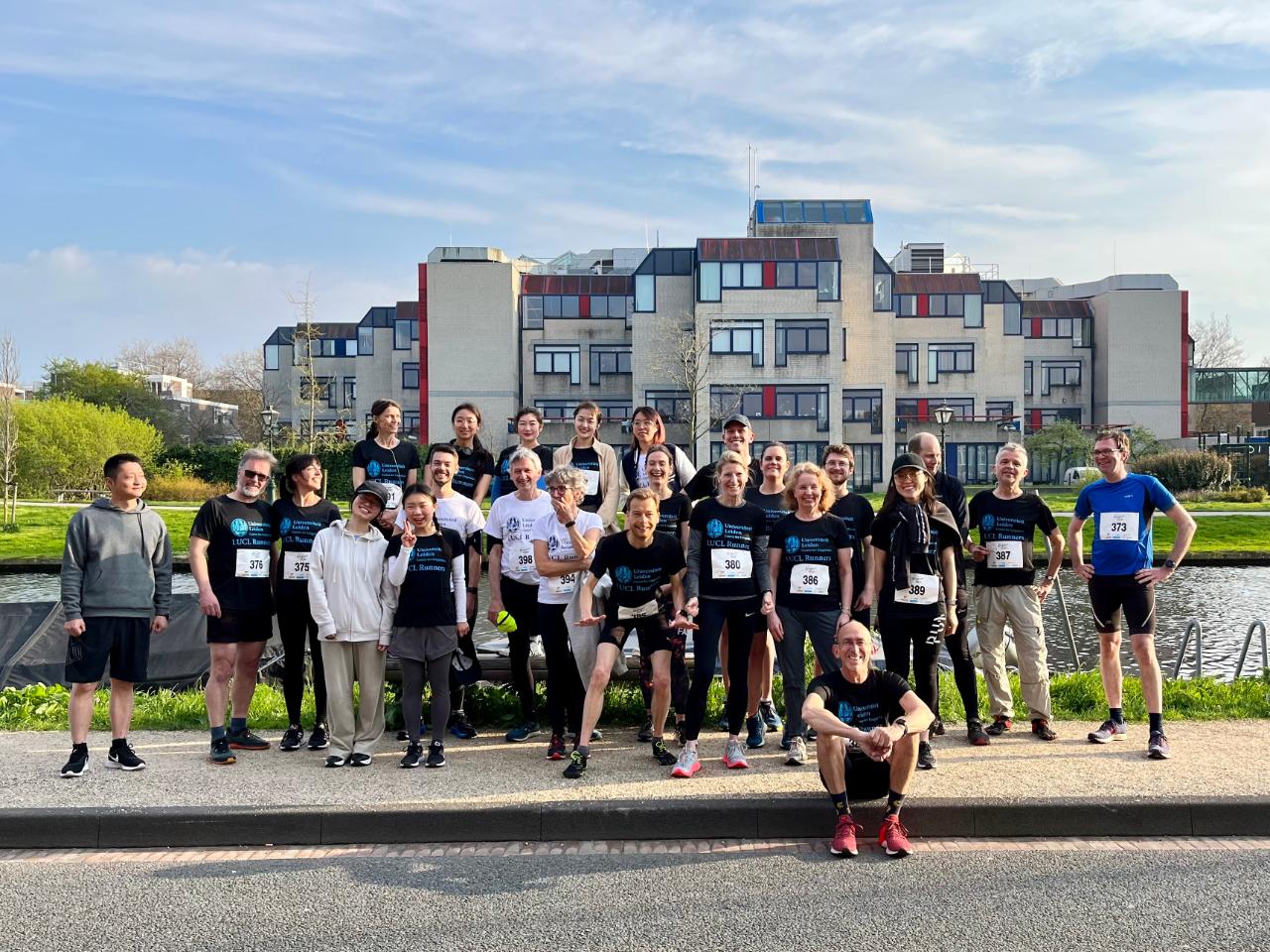
Last Friday, 17 April 2026, a group of linguists from LUCL — the ‘LUCL Runners’ — ran the Leiden Singelloop. All running linguists completed the +/- 6.5km course along the ‘singels van Leiden’. My wife also joined and I ran with our son in his stroller. As the course is way to narrow for the massive amount of people participating, the first part was a bit of a struggle, dodging people and trying to keep running, but after that, it went fine and it was great again to see all those happy faces in the equally massive crowds when they saw our small son waving to them.
Afterwards, we enjoyed each other’s company during the annual post-run party at Olga van Marion and Ton van der Wouden’s house along the route. Thanks to LUCL for sponsoring and all colleagues who supported us during the run!
A few days ago, I received an email from triathlon coach Karen Parnell of Chili Tri, who suggested a new feature for the running and swimming metronome tool. She explained that swimmers flick through various metronomes (with varying beats per minute), without being able to look at a display. The feature Karen suggested was to include an option which would add a short audio description at the start of the metronome MP3 stating the beats per minute (BPM).
Chili Tri coaching
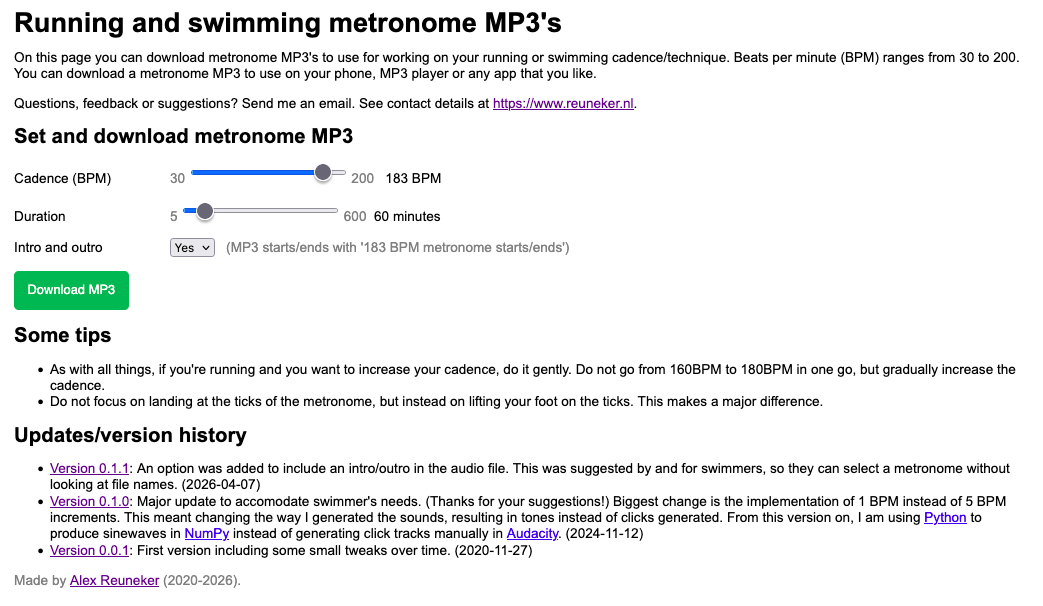
As I find programming such features nice small side challenges, I got to it pretty soon after receiving the email and I used the opportunity to clean up some code at the same time. So, now the running and swimming metronome tool has an option to add an intro and outro to the MP3 file stating the BPM of the metronome. Simple as that. Swimmers can now select a metronome without needing a display in the water to look at file names.
The new intro/outro option in the running and swimming metronome tool
I have asked Karen whether she would be willing to write a small text describing what she uses the metronome tool and the resulting MP3 files for. She was kind enough to do so, so here we go.
I’ve found that using an audio metronome can be incredibly effective for swimmers, as it provides real-time rhythmic cues to help maintain a consistent stroke rate and improve pacing efficiency in the water. Creating audio files with your target stroke rate gives you something simple to follow during your swim and helps keep your rhythm on track. This can be especially useful during longer open water sessions — listening for a minute or so to reset your rhythm, then turning it off to swim naturally. I personally use the Reuneker metronome web tool to create simple audio files for both my runners and swimmers.
Check out the new option at https://www.reuneker.nl/files/metronome and generate some MP3’s to see whether it is useful to you too. Happy swimming, running and cycling!
On Friday 23 January, 2026, I ran a marathon on my treadmill in preparation for a 60K ultra-marathon (the Zestig van Texel). As I was at home with my 1.5 year old son, who I could keep monitored while he was asleep this way, this long run had to be done on the treadmill in my garage.
Most of my long runs I run at 4:20-4:30 per kilometer, but I thought it would be a ‘fun’ challenge to run a sub-3 hour marathon on a treadmill once, requiring a pace of at least 4:16 per kilometer. Will I make it within 3 hours?
For those interested in doing a treadmill marathon themselves, or those who just want to see an admittedly somewhat crazy experiment, I have made a summary video (<5 minutes) showing running footage with pace, distance and other details overlayed, and some technical details, lap times, evaluation et cetera. Watch it at https://youtu.be/ZMJDv8gvqso.
It was a fun experiment, but an experiment at that. I don’t plan doing another treadmill marathon soon.
Last Friday, my wife and I took our son to Leiden to run the Singelloop — a very family friendly running event. It was fun, although I was used to starting and running in front. Pushing a stroller, I though I shouldn’t start in front this year, because that should be reserved for people actually racing. It took around 2 kilometers to get used to running really slow and just enjoying the run as a family activity instead of a running activity.
Stroller-running at the Singelloop 2025
The biggest challenge was to maneuver the stroller around and past other runners, but I kept in mind that I was the ‘exception’ here and I should watch out, not others. What definitely helped, were all the positive reactions and cheers by other participants and the massive amount of supporters along the route. Thanks, Leiden!
Last Friday, 11 April 2025, around 20 linguists from LUCL — the ‘LUCL Runners’ — ran the Leiden Singelloop. All running linguists completed the +/- 6.5km course along the ‘singels van Leiden’. Afterwards, we enjoyed each other’s company during the annual post-run party at Olga van Marion and Ton van der Wouden’s house along the route. Thanks to LUCL for sponsoring and all colleagues who supported us during the run!
The LUCL team of 2025
It was a bit of a challenge to run with our son in his stroller along parts the small, crowded route, but it was fun!
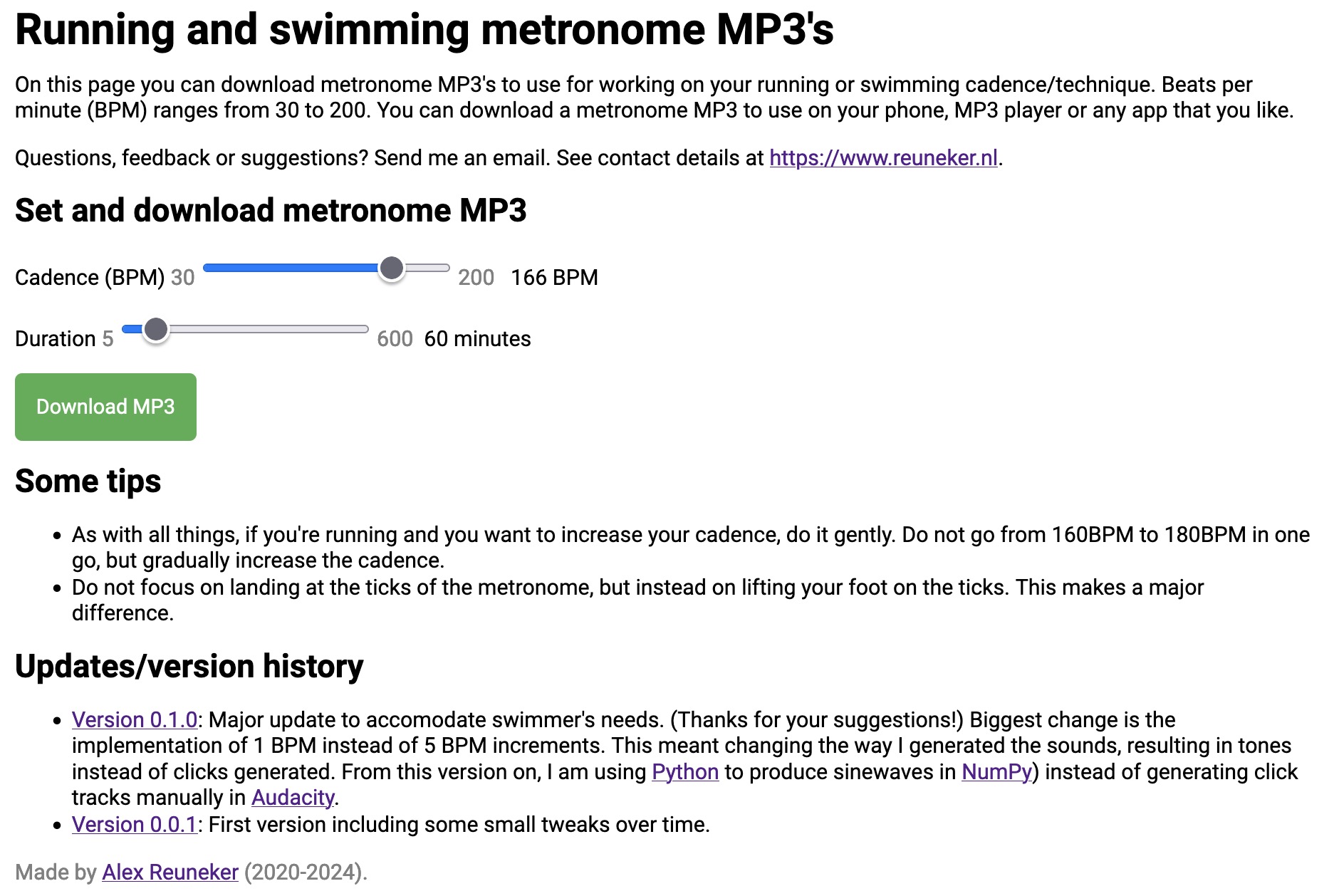
Again, an update to the metronome tool, but this was a rather large one, especially ‘behind the scenes’. The update was done because of a couple of mails I received from swimmers. I didn’t really know swimmers used metronomes, but it does make sense. Their needs are different from runner’s, however – BPM’s as low as 30 are not something I ever thought of as a runner. One of the swimmers also mentioned that it would be really helpful to generate metronomes in steps of 1 BPM in stead of the 5 BPM the previous version of the tool offered.
The new version of the metronome tool, with 1 BPM increments
Offering metronomes by increments of 1 BPM meant either much manual work (for every frequency I had to manually generate a 1 minute click track in Audacity, resulting in almost 200 manually created and converted files), or radically changing the way I generated the 1 minute tracks. I opted for the latter, as it meant both a (small but fun) programming challenge, and it would be more lasting solution. From this version on, I am using a Python script I wrote to produce sinewaves in NumPy.
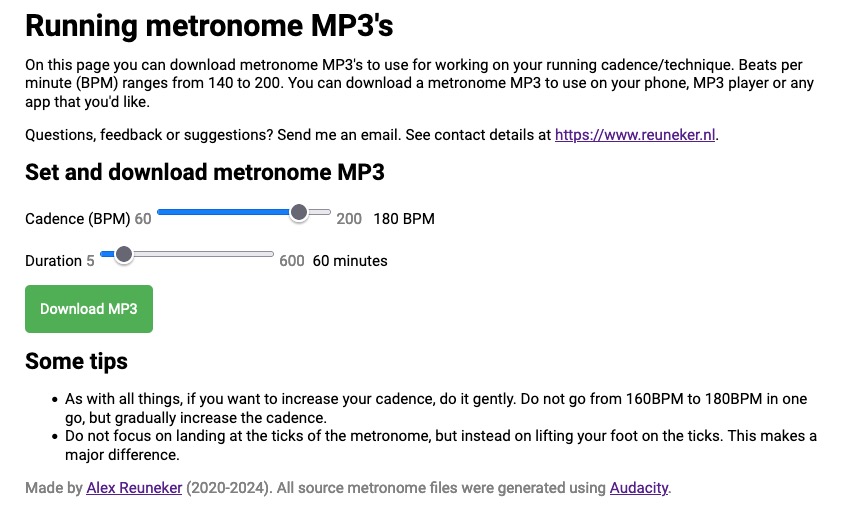
In 2020 I created a simple page with downloadable metronome MP3 files, ranging from 170 to 200 BPM. Each MP3 is an hour long and can be looped in your favourite player. This was sufficient for my purposes, but I (somewhat) recently received some emails from people who used the page not (only) for running, but also for swimming and other activities. They asked for longer MP3’s and lower BPM’s. I’ve updated the tool accordingly, and BPM can now be set as low as 60 BPM and maximum duration is increased from 60 to 600 minutes (yes, that is 10 hours).
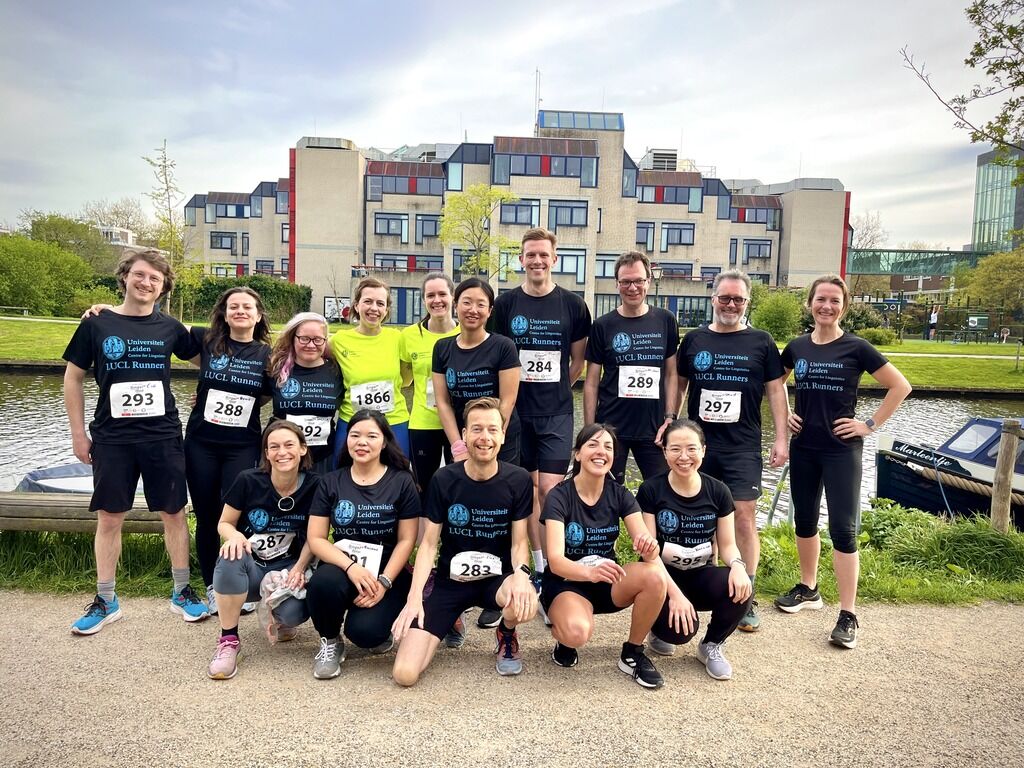
On Friday 12 April 2024, 15 linguists from LUCL — the LUCL Runners — ran the Leiden Singelloop. All running linguists completed the +/- 6km course on the ‘singels of Leiden’. Afterwards, we enjoyed each other’s company during the annual post-run party at Olga van Marion and Ton van der Wouden’s house along the route.
The LUCL team of 2024
Thanks to LUCL for sponsoring and all colleagues who supported us during the run!
Last Friday, 25 linguists from LUCL ran the Leiden Singelloop. After a nice, light dinner in the common room, all running linguists completed the 6K on the ‘singels of Leiden’. Afterwards, we enjoyed each other’s company during Ton van der Wouden’s annual post-run party at his house along the route.
The LUCL team of 2023
Thanks to LUCL and all colleagues who supported us during the run!
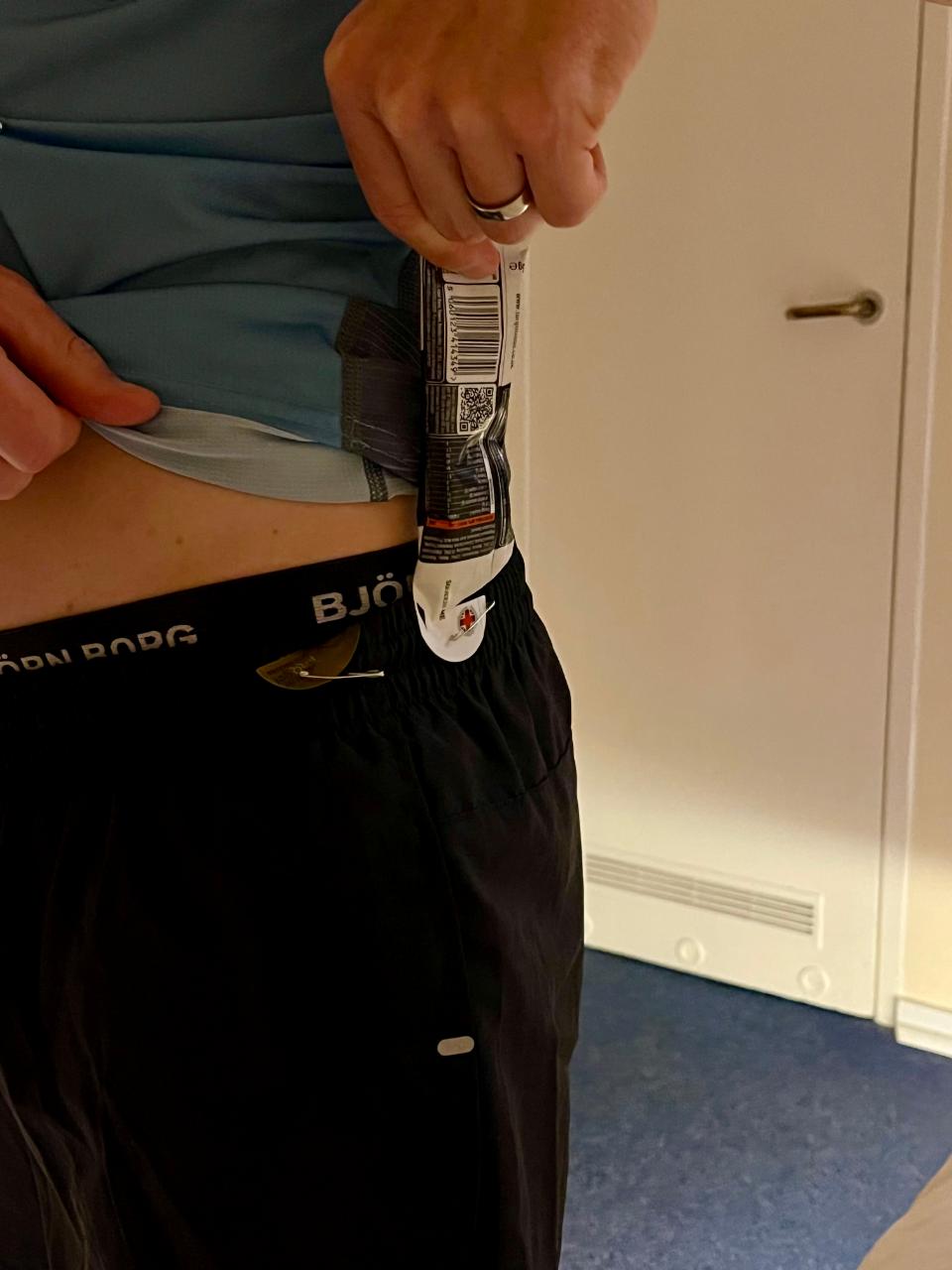
Here’s just a quick tip for carrying gels while running longer distances. I only carry them for marathons, and I kind of hate the feeling of those waist bands. Turns out, you can carry them safely without buying anything.
All you need are your regular safety pins — you know, those things they hand out at every race for attaching your bib to your shirt. Take a gel, put it inside your shorts on the left or right side, and flip the top over your waist band. Attach the top to your shorts using a safety pin and it won’t go anywhere during your race.
When you need it, just tuck it from your waistband – it’ll let go easily – but be aware that the pin might open, so don’t get stung. I found this works great and the gels don’t bounce up and down while running. I carry three gels at most, so I don’t know whether this works for more gels.