The Evenings, day 7: 28 December 1946/2025
Day seven of The Evenings. Seven comes after six, and that rings of 'six-seven', children's word of the year of 2025 in The Netherlands! You can read about that at NOS Jeugdjournaal. Think of it what you will, but let's use this interesting word as a gateway into today's chapter.
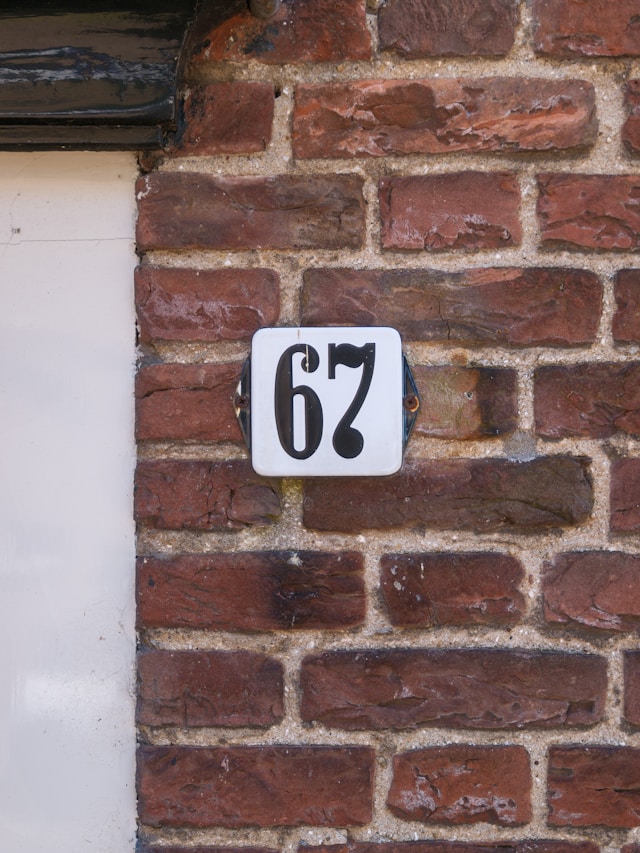
Photograph by Haberdoedas on Unsplash
The 67th word – which you can easily find using the Lexical Diversity Calculator – is mother, with which Frits' mother ends the following note she left for him.
Dear Frits. I don’t know where Father is. I have gone to Annetje’s. I will be home around eleven. There is pea soup, and you can take a piece of meat if you like. Just fry some potatoes along with the onions. Until then. Mother.
It really is a quite touching note, as Frits' parents clearly have relational issues, and while Frits really doesn't speak nicely of his parents, he does seem affected by their quarrels. His mother leaving for the day is not the first time, and I think it makes Frits' isolation the more apparent.
So what about the 67th sentence? You can find it using the Sentence Length Tool. Here it is: 'He came to a canal where a sand barge lay at anchor.' Frits just listened a bit to the radio and doesn't know what to do next, being home alone. He decides to go rest a bit, as not to be 'drowsy this evening.' He hears children playing, dozes of and dreams of a ship with a funeral cross. When he finally wakes up at five thirty, the chapter reads, his pillow is wet with tears.
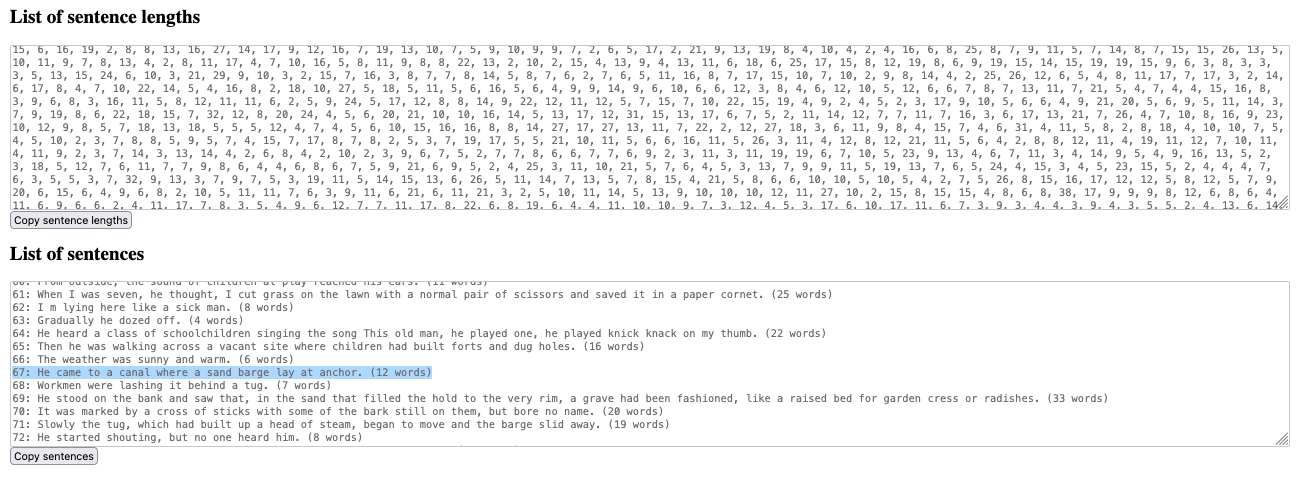
The 67th sentence in chapter 7 of The Evenings
While it is easy to critize Frits for being distant, sarcastic and very judging all the time, this chapter always reminds me to feel sorry for him too. The situation with his parents at home is less than stellar, and after not finishing school, Frits seems to be one of the few who hasn't moved on in life, his former school friends studying, being in relationships, et cetera. I think Frits' sarcastic comments, and his reliance on silly anecdotes for social interactions reflect his loneliness and his sense of it all being meaningless.
Returning to six-seven, Kristel Doreleijers, linguist at the Meertens Instituut, explains to NOS Jeugdjournaal that 'it's really a word of this year, but it doesn't have much meaning [...]'. Maybe that's what also lacks from Frits' life at this point: some meaning, something to rival the hopelesness of feeling not to have a purpose in life.