Join us in Paris for the winter school ‘Conditionals – Theory, Typology, Diachrony and Corpora’, taking place from 1 to 4 February 2027. Explore the fascinating world of conditional constructions (‘if P, then Q’) from perspectives such as theoretical and diachronic linguistics, typology, logic, and corpus studies. The school brings together researchers and students interested in the ways conditionals work across languages, times and contexts. With an interdisciplinary programme and opportunities for discussion and exchange, this is a great opportunity to deepen your knowledge and connect with fellow researchers.
Pôle des langues et civilisations de l’Inalco. Copyright: Sophie Lloyd
Registration is now open for all researchers and students, from all locations and countries. Find out more and to sign up, see https://contend.sciencesconf.org/?lang=en.
Unfortunately, the already postponed ‘summer school’ on conditionals, Conditionals in Paris, was canceled or postponed yet again, due to the ongoing riots in Paris (and other big cities in France). INALCO is closed and from what I understand, it will not be open nor host any academic activities next week.
I had put a lot of work and stress in it already, as did the organization and the other instructors, so it truly is a pity, but of course, it is even a bigger let down for the students who were to participate in the school, and for whom we were preparing it in the first place. Hopefully to be continued.
Next week, I will be teaching a course at the l’Institut national des langues et civilisations orientales (INALCO) in Paris. The course, Conditionals: From types in theory to uses in corpora, focuses on types of conditionals or ‘if-then constructions’ distinguished in the (cognitive) linguistic literature, their implicatures and also incorporates some hands-on corpus experience. Other courses that week provide an introduction to the logic of conditionals, shed light on their form and meaning, discuss the counterfactuals, and their causality.
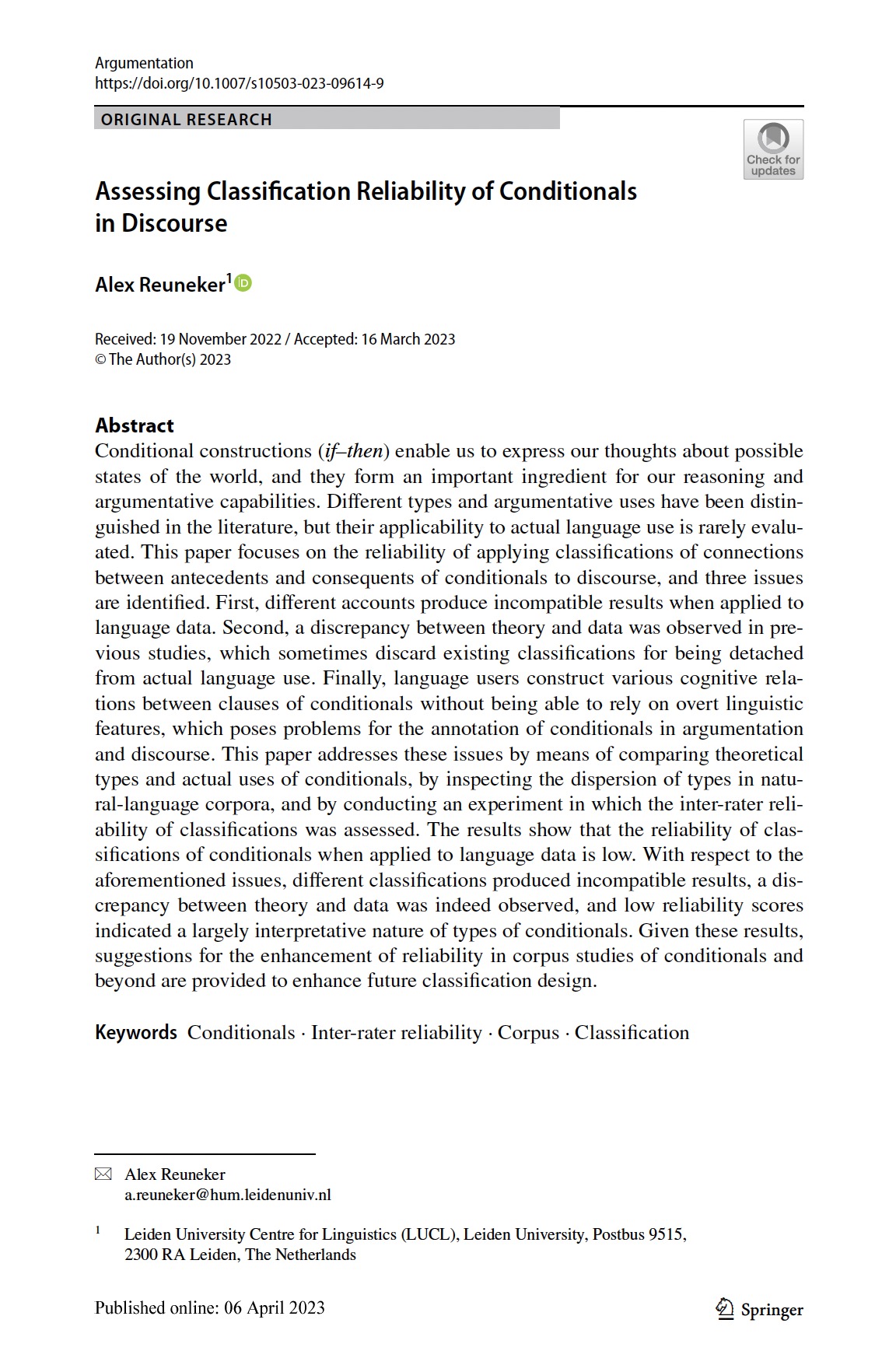
Different types and argumentative uses of conditionals (if-then) have been distinguished in the literature, but their applicability to actual language use is rarely evaluated.
As ‘the proof of the pudding is in the eating’, my new paper in Argumentation (Springer) entitled ‘Assessing Classification Reliability of Conditionals in Discourse’ addresses this issue by means of an experiment in which the inter-rater reliability of classifications applied to natural-language corpora was assessed.
New publication in Argumentation: ‘Assessing Classification Reliability of Conditionals in Discourse’
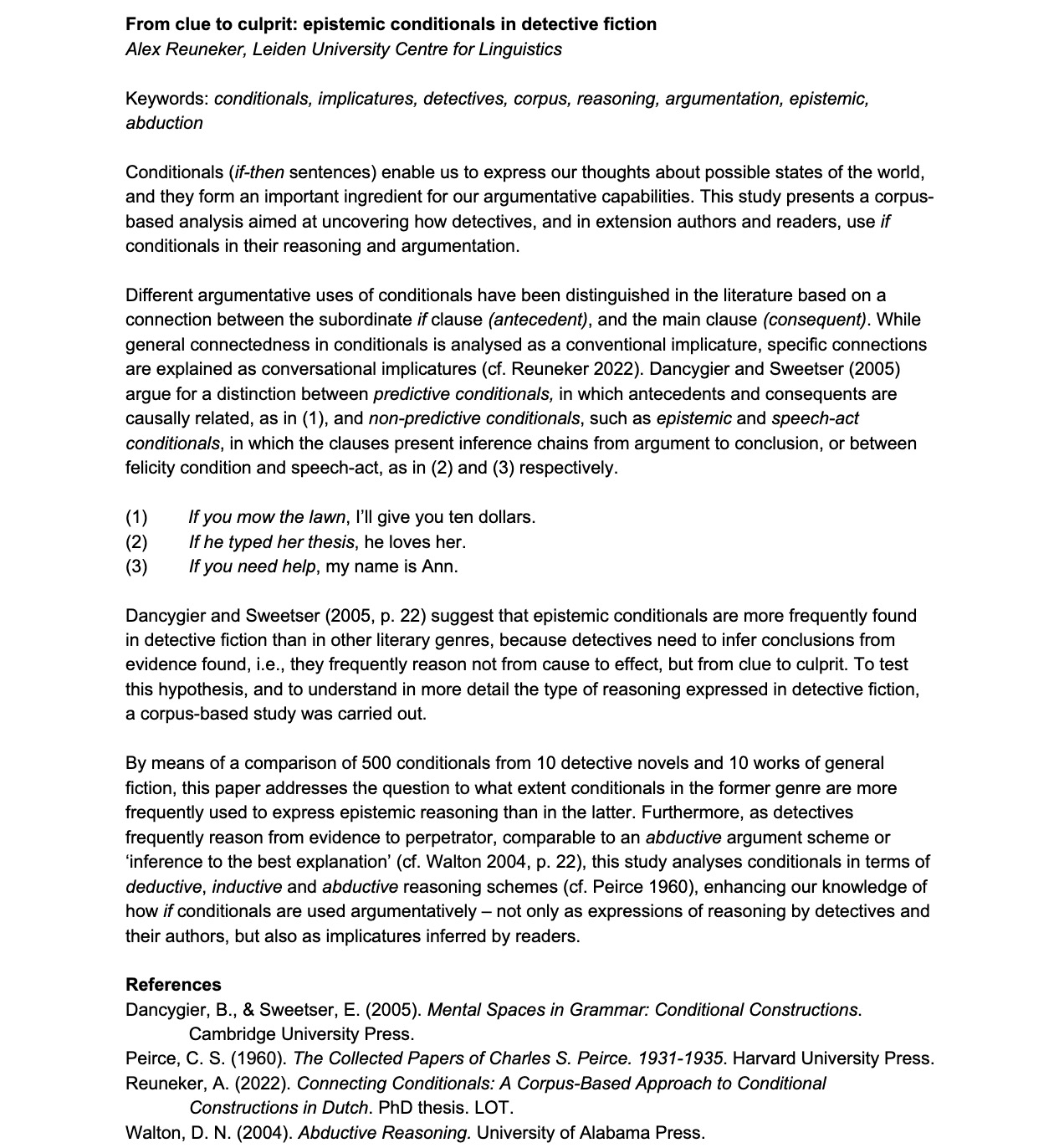
I presented an experiment on the reliabiliy of annotating conditionals in corpus data. I got some great questions and suggestions for further research. Much appreciated! Below you can find the abstract.
Annotation reliability as a preliminary for corpus research
In corpus research, language data are frequently annotated by analysts, but measures of reliability are rarely reported. When annotations concern interpretative features such as implicatures, this poses problems for subsequent steps in the analysis. In this talk, three connected issues are discussed in light of an experiment on classification of coherence relations in conditionals. First, different classifications produce incompatible results when applied to language data. Second, discourse studies observe a discrepancy between theory and data, i.e., existing classifications are “too detached” from actual discourse. Third, while language users construct various cognitive relations between clauses, they do so without relying on overt linguistic features, which poses problems for composing annotation schemes. Based on the results of the experiment, I discuss the implications for corpus research of implicatures.