The Evenings, day 5: 26 December 1946/2025
'AT NINE O’CLOCK, by full daylight, he awoke. "The second day of Christmastide has broken,"" he thought.' It's Boxing Day today. For anyone, like me, who didn't know what 'boxing' stands for in Boxing Day: apparantly it is a tradition to give away boxes of food and clothing to the poor. With that out of the way, let's look at hapaxes in today's chapter of The Evenings!
Hapax Legomena are words that occur only once in a given text. Today's chapter contains quite a lot of them, such as christmastide in the quote above. You can easily index all hapaxes using the Lexical Diversity Calculator yourself, if you whish.
Other hapaxes are daylight, alleyway, and, I'm sorry it caught my eye, fart. I took the liberty of looking into the use of this last word in the chapter – never waste a good rabbit hole when you find one.
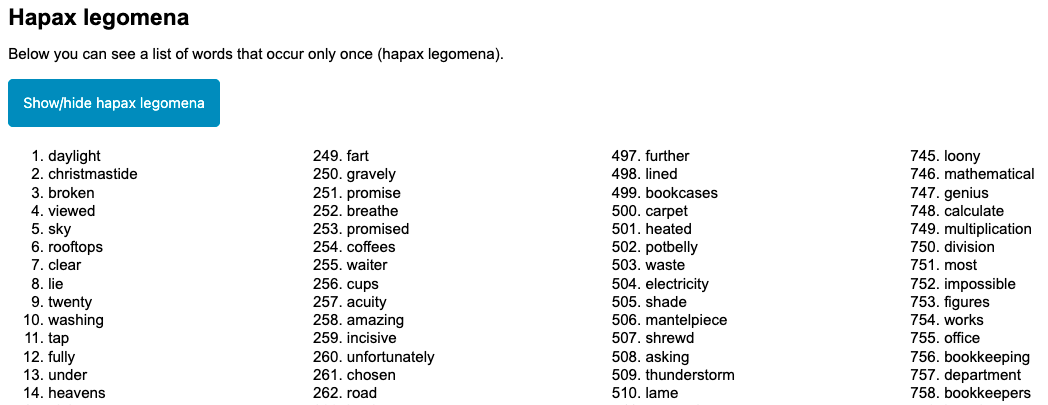
Hapax legomena in chapter 5 of The Evenings
Fart occurs in the following snippet: '"Do you know what that reminds me of?" Frits said suddenly. "Of my grandfather, who’s dead now, the old fart. [...]"' Aha, it's not a literal use of fart! Let's see how Frits calls his grandfather in the original text, as I don't recall seeing the Dutch equivalent of fart being used this way. In the Dutch text, it reads '"Weet je waar ik aan denken moet?" zei Frits plotseling, "aan mijn grootvader, hij is nou dood, die oude hoer. [...]"' How interesting, oude hoer is translation into old fart. If you ask me, altough both the original and the translation explicitly mention oud/old, old fart does not have the idiomatic meaning of oude hoer in Dutch, which has to do with excessive talking, whining or nagging.
I couldn't help myself and went over to the Etymologiebank to check my intuitions. Sure enough, it says 'ouwehoeren komt al voor in Kamertjeszonde (1896) van Herman Heyermans. En het scheldwoord ouwehoer (zeurder) werd al teruggevonden in ‘Het Sermoen’, een geschrift in het Maastrichts uit 1729!' ('Ouwehoeren (whining) already appears in Herman Heyermans' Kamertjeszonde (1896). And the insult ouwehoer (whiner) was already found in Het Sermoen, a Maastricht dialect work from 1729!' Apparantly, reading the rest of the entry on ouwehoer(en), the verb ouwehoeren became popular among soldiers in in the former Dutch East Indies.

'Ouwehoer' in the Etymologiebank
Now, I could be mistaken, but old fart generally refers to old-fashioned persons, not overtly talkative ones. In today's chapter, the quote appears in an episode in which Frits talks to Maurits, right after the following segment: '"You had better keep your mouth shut," said Maurits, "you talk too much." "Come now," Frits said, "I know what I’m saying. Don’t worry. Besides, I have a great respect and fondness for you." Maurits grimaced.' So, we are definitely in the realm of people talking too much, and it seems the translation of oude hoer into old fart doesn't cover that aspect.
Interestingly, my wife, who is reading the Dutch original this year, told me that a couple of pages before the occurrence of oude hoer referring to Frits' grandfather, Frits refers to himself as follows: 'Ik ben niet zo'n oude hoer, om zo iets te zeggen.' Here, the English translation reads 'I’m not the kind of gasbag who would say something like that.' So, here oude hoer is translated into gasbag, which, according to the Cambridge Dictionary means 'a person who always talks too much'. I guess that translation reflects the original much better.
With that, have fun reading today's Chapter!