§287. The Evenings, day 2: 23 December 1946/2025
Today, we’re reading chapter 2 of The Evenings. I thought it would be fun to look at sentence lengths in that chapter and compare them between the original Dutch text and the English translation. There’s no reason to expect a real difference — it’s simply for fun.
First, the Dutch text. pasting the chapter into the sentence-length calculator at https://www.reuneker.nl/files/senlen tells us that there are 650 sentences, with a total number of 6720 words, and an average of 10.34 words per sentence (sd = 6.28). For the English translation, there were 3 sentences more (653), with a total number of 7135 words, and an average of 10.93 words per sentence (sd = 6.81). We already see that these numbers are very similar, but let’s test for a difference anyway to see if there’s something interesting to be learned.
Using the t-test calculator at https://www.reuneker.nl/files/t we get the following results. For De avonden (n=650), the sum total of words is 6720, the minimum number of words in a sentence is 2, the maximum is 40, the mean is 10.34, the median is 9 words, and the standard deviation is 6.28 words. For The Evenings (n=653), the sum total of words is 7135, the minimum number of words in a sentence is 2, the maximum is 44, the mean is 10.93, the median is 9 and standard deviation is 6.81. The difference in sentence lengths between The Evenings and De avonden is not significant (t (1301) = 1.62; p >= 0.05). The effect is negligible (Cohen’s d = 0.09; Cohen, 1988). In a boxplot, that looks like this — indeed, nearly identical.
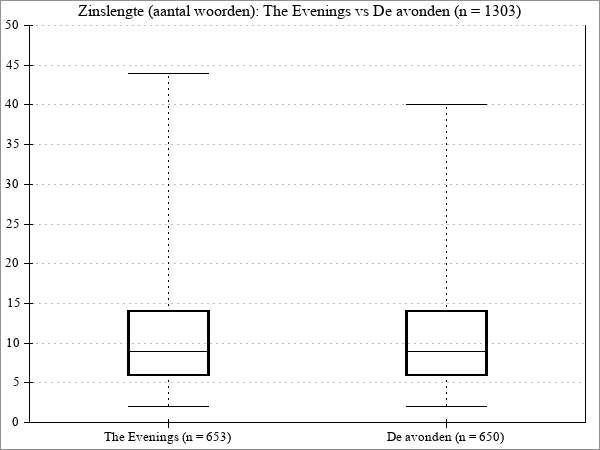
Sentence lengths in De avonden and The Evenings
So, which sentences are those very long ones, then? And are they the same sentences across both editions? The answer is yes, as you can see below.
Dutch
Op de trap, bij de kaartencontrole, troffen ze elkaar weer en liepen langs een spandoek met het opschrift Berends gymnasium, 1926-1946 naar boven, waar ze in een hal, kleiner dan die beneden, voor de ingang van een zaal kwamen.
English
At the foot of the stairs, where the ticket takers stood, they met up again and climbed past a banner reading Berends Gymnasium, 1926-1946 and then, in a hall even smaller than the one below, found themselves before the entrance to an auditorium.
Geef een reactie